Scientist-CEO with 23 years translating research into commercial healthcare. Built Tech Care for All — 350,000 HCPs, 280 institutional partners, Rx & MDx -India & Africa ;Telemedicine & EMR. Founder…
Smartphone Clinical AI Diagnostics
One Platform. Every Device. Every Market.
Norma normalises smartphone camera output to a device-agnostic clinical standard — enabling AI diagnostic models to deliver consistent, auditable accuracy across every consumer device, every market, and every firmware version.
The Problem
Consumer devices evolve in 3–6-month cycles. Regulatory approvals lock on 2–5-year cycles. This gap is unmanaged, unpriced, and accelerating.
Every firmware update can invalidate locked clinical claims. Expensive re-submissions. No infrastructure currently prevents this.
ISP pipeline changes silently degrade diagnostic AI accuracy with no error signal, no alert, and no audit record. The AI answers anyway.
No device-level audit record means no defence when an AI diagnostic outcome is challenged in court or by a regulator.
No standard mechanism exists to demonstrate device-agnostic consistency for regulatory submissions or real-world evidence dossiers.
Per-unit physical deterioration corrupts output on a device-by-device basis — invisible to population-level normalisation approaches.
Device ecosystem variation between geographies is indistinguishable from genuine clinical variation — corrupting real-world studies.
Founding Story
In 2025, our founder led the deployment of a smartphone-based deep-learning AI diagnostic application across India and Africa. The model had achieved 96.7% accuracy in controlled settings, had a clear regulatory pathway, and $14M had been raised to deploy it.
It failed. Not because of the AI — because every consumer smartphone applies its own proprietary image signal processing (ISP) pipeline, tuned for social media photographs and not for clinical statistics. A conjunctiva photographed on an iPhone renders entirely differently on a budget Redmi. The AI answers anyway.
This was not a product failure. It was a structural infrastructure gap. Others are addressing device variability at the model layer — fine-tuning AI per device. That treats the symptom. Norma fixes the cause: device-agnostic signal normalisation before any AI model runs.
"This was not a product failure. It was a structural infrastructure gap — and it is unmanaged, unpriced, and accelerating."
The Insight
Iris recognition, facial verification, and fingerprint identification all confronted identical challenges: the same iris looks different on different sensors. The same face renders differently under different camera hardware.
The industry's solution: normalise to a canonical representation before feature extraction. Not AI. Not retraining. Deterministic, hardware-invariant signal processing applied at the input layer.
This approach is now codified in ISO/IEC 19794-6 — the international biometric cross-sensor normalisation standard, applied in every compliant iris and facial recognition system globally.
Every clinical AI deployed on consumer smartphones confronts the same cross-sensor problem — and ignores it. Models are trained on curated device sets and fail on the budget Androids that patients in LMICs actually own.
No clinical AI middleware has applied the biometric industry's proven solution to this problem. There is no ISO/IEC 19794-equivalent standard for smartphone clinical imaging. No deterministic normalisation layer. No regulatory audit trail.
Smartphone ISPs are tuned for photographic aesthetics. They are not clinical instruments. Treating them as such — without normalisation — is the defining infrastructure gap of the decade.
Norma applies the biometric industry's proven architectural standard to clinical AI. Not a novel invention. The correct solution, applied to an adjacent problem.
The Platform
A three-layer architecture: an open SDK, a proprietary intelligence layer, and a diagnostic product pipeline.
A device-agnostic image signal processing normalisation SDK. Any developer, any SaMD company, any research institution integrates without licence fees, legal review, or permission. Our goal is to democratize smartphone based Clinical AI solutions.
Continuously maintained device profile library, real-time firmware drift monitoring, and a per-image immutable audit trail built for regulatory submission. Making it easy for every SaMD company's regulatory dossier, referenced to a specific Norma library version.
A pipeline of non-invasive digital diagnostic products across eye-based and mucosal imaging modalities — all running on the Norma SDK. Clinical trials validate the evidence base.
Traction
Diagnostic Pipeline
Eye-based and mucosal imaging. Community deployable at a fraction of the cost of current diagnostics. No blood draw. No connectivity required.
Non-invasive blood biomarker screening via conjunctival imaging. Community health worker deployable.
Non-invasive deficiency screening via conjunctival imaging. CDSCO-targeted indication.
Exploratory biomarker detection via conjunctival imaging. Dataset development in progress.
Non-invasive status assessment via oral mucosal imaging. CDSCO-targeted indication.
Exploratory skin-based biomarker detection across diverse population datasets.
The Team
All four have built, operated, or commercialised healthcare products from the ground up — and one of us has lived the exact failure we are solving.
Scientist-CEO with 23 years translating research into commercial healthcare. Built Tech Care for All — 350,000 HCPs, 280 institutional partners, Rx & MDx -India & Africa ;Telemedicine & EMR. Founder…
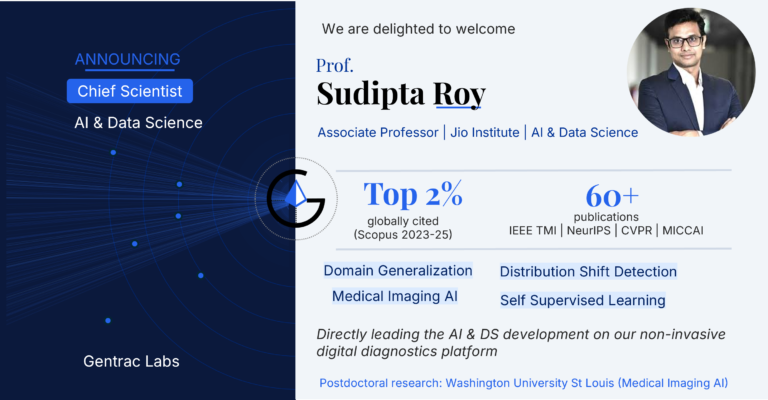
Associate Professor in Artificial Intelligence & Data Science at Jio Institute. Specialist in domain generalization, distribution shift detection, self-supervised learning, uncertainty-aware deep learning. Leveraging AI to expedite clinical trials in…
Commercial operator with a live IVD network across India and APAC (private and public sectors). Currently India Marketing for an MNC IVD- live hospital procurement, lab director, and IVD distributor…
Deep IVD market relationships across India — public and private lab chains, hospital procurement, and diagnostic ecosystem navigation. Guiding TPP definition, clinical trial design, and private lab commercial engagement.
Insights
Beyond the “Black Box”—Building Trust in High-Volume CareLive from Delhi at the Health AI Summit! Consensus among the…
Accuracy in your healthcare AI application is worthless if it isn’t actionable. 📉 🧠#GRIF Post 4: Explainability (XAI)…
Healthcare AI models also fail because the “lab” (training) data is “too clean” 📉If your underlying healthcare AI…